Brain training made for chess players
Chess is played in your head. Train there.
Grandmasters can play a whole game without looking at the board. That skill is not magic. It is trained. NeuroChess is the gym for it.
- Five training games
- Works offline
- No account
- Pay once, no subscription


In final testing on Android, with iPhone right behind. Free to start, with all five games in the free version.
The skill behind every move
Every strong player sees the board in their head
They follow a line many moves deep without touching a piece. They never lose track of where everything stands. They stay locked in until the move that matters. Most chess training ignores this. NeuroChess trains it directly: five games, each working one mental skill, every one of them played with chess pieces. It is built to improve your game where games are won and lost: in your head.
See deeper
Follow longer lines in your head and still see the final position clearly. Stronger players look further ahead. This is where you practise looking further.
Deep · Puzzles
Remember more
Hold the piece, hold the square, hold the order. The memory you calculate with is a muscle you can work, one rep at a time.
N-Back · Sequences
Stay focused
A long game is hours of quiet moves and a few critical ones. Train the concentration that is still there when the critical one arrives.
Combos
The five games
Five ways to train the thinking behind your moves
Two are chess itself: real positions, real moves. Three are tasks that memory and attention researchers have used for decades, rebuilt with chess pieces. Each takes a minute to learn and has plenty of room to grow.
Tactics decide games. Then solve them blindfold.
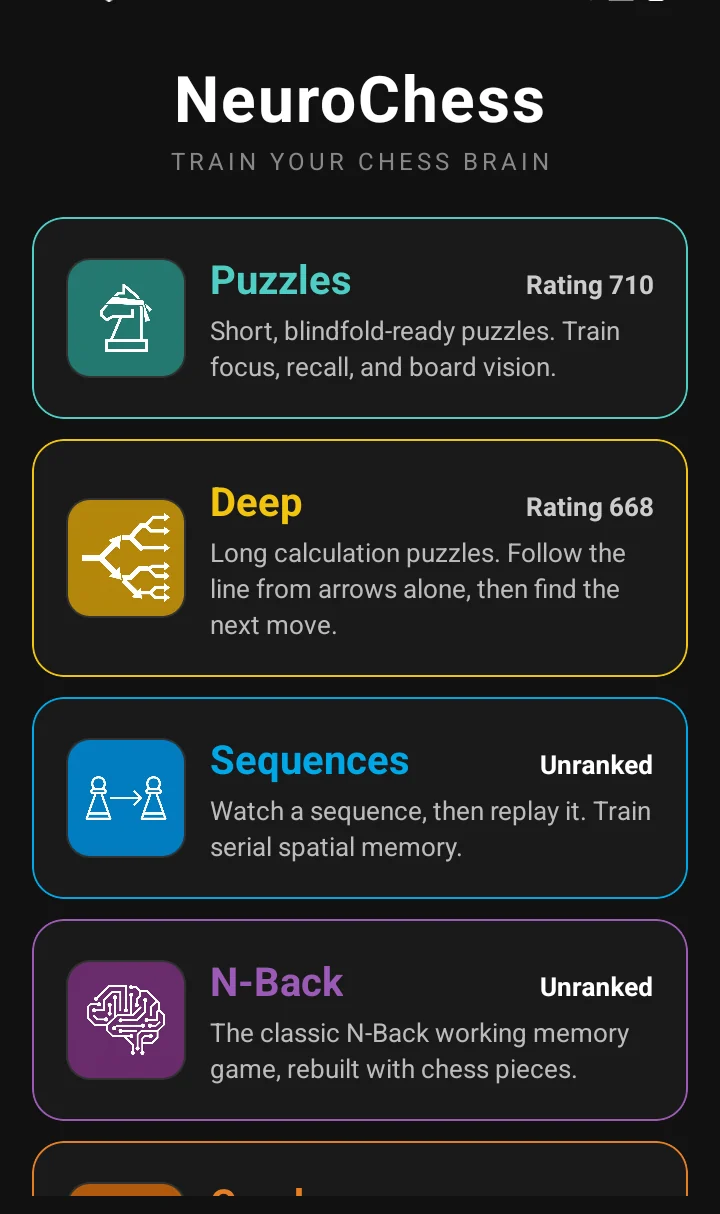
Strong players do not calculate everything: they recognise patterns they have met before. Every puzzle you solve is one more pattern in the bank. NeuroChess gives you tens of thousands of rated tactics from real games, matched to your level, so you always work at the edge of what you can do.
How it works
- You get a position from a real game, picked close to your rating.
- Find the winning move and play it out.
- Solve it at the first try and your rating goes up. Miss and it goes down.
Pieces: Hidden. Train like a blindfold player. You get a few seconds to look. Then the pieces vanish and you solve the position from memory on an empty board. In a game you calculate on a board in your head, and Hidden mode trains exactly that, with its own blindfold rating to chase.
Blind Spot. The app finds the themes you miss most often and drills them, without telling you the theme first. Nobody tells you the theme in a real game either.
“We have no doubt that improving your blindfold play will inevitably improve your regular chess.”
Eliot Hearst and John Knott, Blindfold Chess (2009), as quoted in the ChessBase review
How deep can you see?
In a real game you cannot move the pieces while you think. Deep works the same way. A line is played out as arrows on a board where the pieces never move. You keep the changing position in your head, then you find the next move.
This is calculation with the training wheels off: just you and the position in your mind. Start one move deep. Work up to nine and beyond.
How it works
- Take in the starting position.
- The line plays out as arrows, one move at a time. The pieces stay where they are.
- Play the move that comes next. Get it right and your Deep rating climbs.
- Raise the Depth when it starts to feel easy. It will not feel easy for long.
“Sometimes 15 to 20. But the trick is to correctly assess the position at the end of the calculation.”
Magnus Carlsen, asked how many moves ahead he can calculate. Der Spiegel interview, 2010
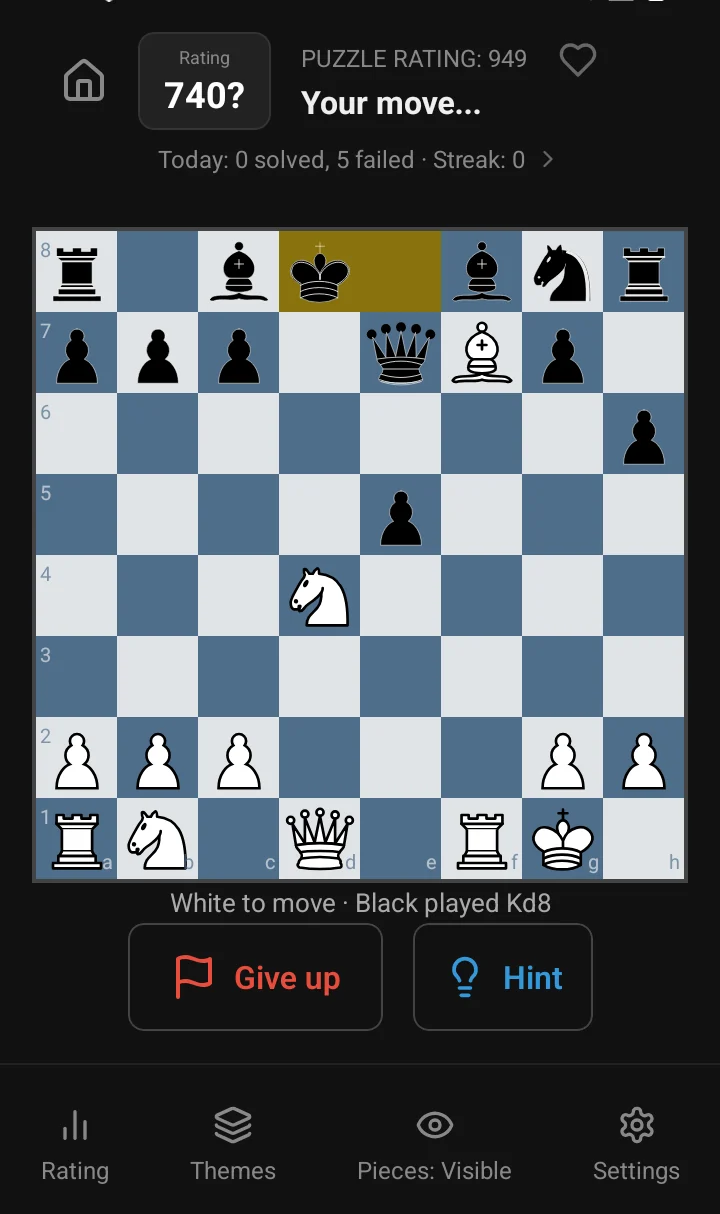
Try one now. Nine moves, and not one piece moves. What does Black play next? The app tells you if you are right.
How many moves can you hold?
A line of play is a sequence: this square, then that one, then the next. Lose the order and you lose the line. Sequences is built on a spatial memory task that researchers have used for over 50 years. Most adults manage five or six. Sequences goes to nine. See how far you can push it.
How it works
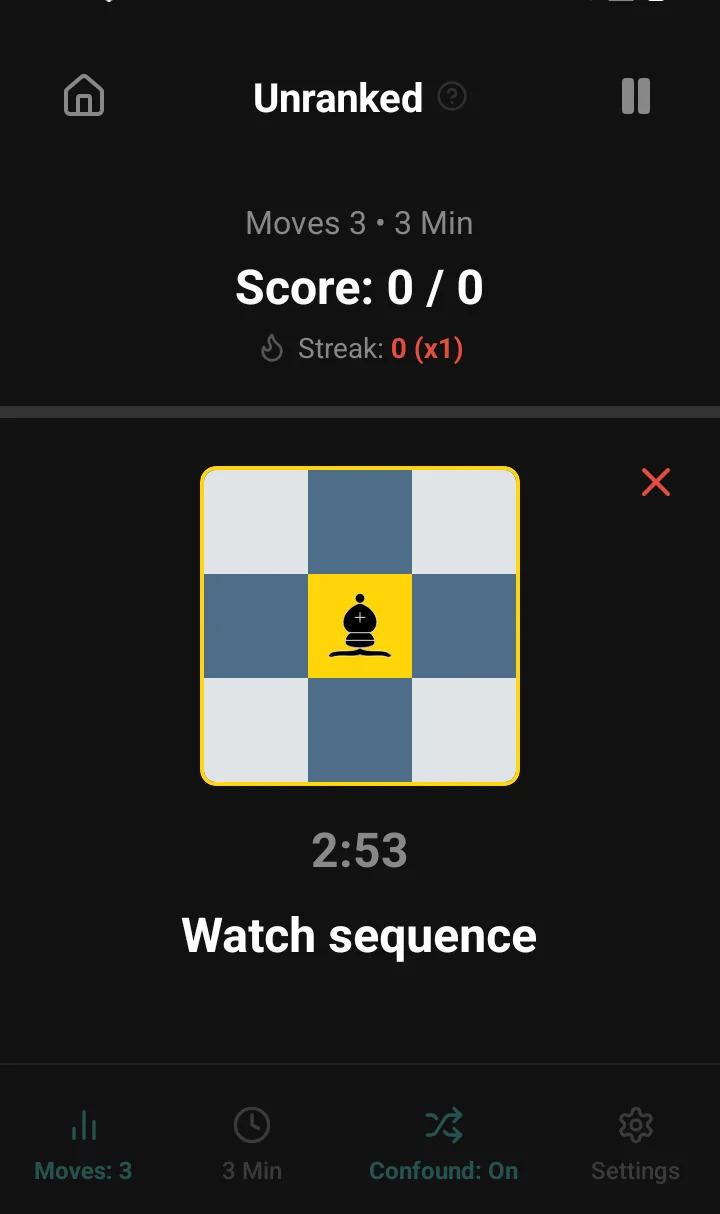
- A piece appears on one square after another.
- The board clears. Tap the same squares back in the same order.
- Add a move each time you master a length, from one up to nine.
- Turn on Confound and decoy pieces appear that you have to ignore.
Hold more of the board in mind
Calculation falls apart when the picture fades. N-Back makes you hold it and update it, again and again, faster and deeper. The n-back task is one of the most studied working-memory exercises in psychology. Here it is played with chess pieces: hold the piece, hold the square, update, repeat. The same habit you need every time you calculate one move further.
How it works
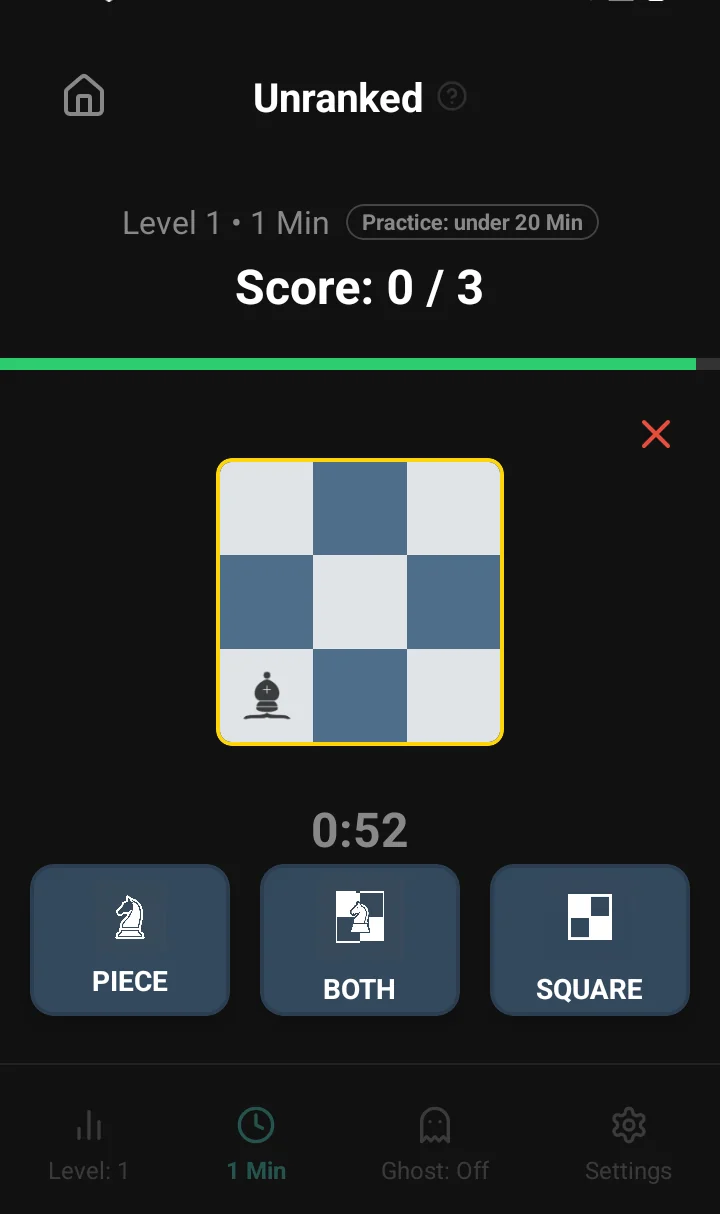
- Chess pieces appear one at a time on a 3x3 board.
- Does the new one match what you saw N steps back? Tap Piece, Square or Both.
- Level 1 looks one step back. Level 9 looks nine steps back.
- Earn your rank, from Beginner all the way to Super GM.
Nine levels. Level 2 is where it starts to bite.
One lapse loses a game
Concentration is a skill, and it can be practised. Combos is modelled on an attention game designed by researchers at the University of Cambridge. In their study, people who trained on that game scored higher on a standard attention test. Now the stream is chess pieces, and the training fits in your pocket.
How it works
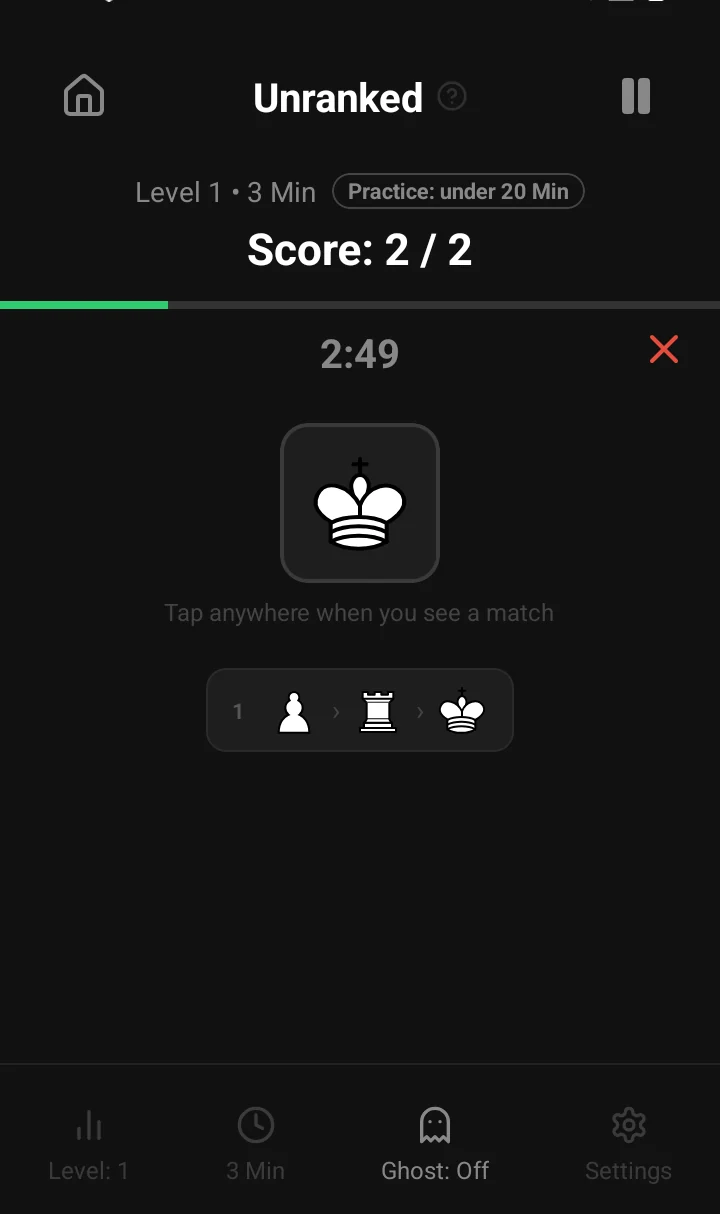
- Chess pieces stream past, one at a time.
- You have target patterns: runs of three pieces in a set order.
- Tap the moment the last three pieces match a pattern. And only then.
- One pattern to watch for at Level 1. Nine at Level 9.
“You have to stay focused, because one mistake is enough to cost you the game.”
Hikaru Nakamura. Interview, 2016
See yourself improve
Every session leaves a mark
Training sticks when you can see it working. NeuroChess keeps score on everything, so the numbers show you how far you have come.
- Three ratings. One for Puzzles, a separate one for blindfold solving, and one for Deep.
- Ranks to earn. N-Back, Sequences and Combos take you from Beginner to Super GM.
- Day streaks for every game, with a flame that changes colour at each milestone.
- A Progress screen in every game: totals, bests, records and your longest streak.
- A daily reminder at the time you choose, if you want one.
- Your level, always. Puzzles follow your rating, so it is never too easy and never out of reach.
No strings
No subscription. No account. Works offline.
Pay once
Every upgrade is a one-time purchase. Nothing renews and there is nothing to cancel.
Train anywhere
The puzzles are on your device. Train on a plane, on the subway, or with your phone in flight mode.
Open it and play
No sign-up, no email, no login. Your progress stays on your device.
Free and paid
Start free. Go further when you are ready.
Free
All five games, with an occasional ad between games
- 3,500 puzzles
- Deep, depths 1 to 3
- Sequences up to 3 moves
- N-Back Level 1
- Combos Level 1
One-time upgrades
Buy one game or the whole suite. Any purchase removes the ads.
- Puzzles Expansion: about 70,000 puzzles in total
- Deep Expansion: about 60,000 long lines, depths 4 to 9 and beyond
- Sequences Mastery: sequences of 4 to 9 moves
- N-Back Mastery: levels 2 to 9
- Combos Mastery: levels 2 to 9
- Suite Upgrade: everything above in one purchase
A few minutes, most days
Ten minutes a day beats an hour on Sunday
Skills build with regular practice. Pick one or two games, play a little every day, and let the day streak keep you honest. Twenty minutes of unbroken concentration on a calculation task is exactly what a long game asks of you. Put in the reps, watch your board vision sharpen, and take a deeper, steadier mind to the board.
Want to start today, before the app is out? Read our guide: How to train chess visualization, with five exercises you can do without any app, and Does blindfold chess practice help your chess? All guides.
Want to know what each game is built on? Read the research behind the games, with links to the papers.
Your next game is played in your head. Be ready for it.
See deeper. Remember more. Stay focused. NeuroChess is almost here: leave your email and we will tell you the day it lands.
Request sent. Check your inbox for the confirmation email, and your spam folder. If nothing arrives, try again or write to hi@neurochess.com.
Or warm up in your browser with the free web games: React and Vision.
The puzzles come from the Lichess puzzle database. The players and authors quoted on this page were talking about chess, not about NeuroChess.